Key Takeaways
- Songkran, Thailand's traditional New Year, typically falls on April 13 to 15 and involves widespread workplace closures, with many offices, banks, and government services shutting down for several days around the official holiday.
- Co-working spaces in Bangkok and Chiang Mai generally remain open during the festival, though hours may be reduced; 24/7 member access is available at select locations.
- Workplace Songkran ceremonies, particularly the Rod Nam Dam Hua water-pouring tradition, carry deep cultural significance. Foreign professionals who participate respectfully tend to strengthen professional relationships.
- Thailand's UTC+7 time zone creates a viable overlap window with both European and North American clients, though schedule adjustments are typically necessary.
- For any questions about tax obligations or work authorisation in Thailand, readers are strongly encouraged to consult a qualified professional in the relevant jurisdiction.
Understanding Songkran: More Than a Water Fight
Every April, Thailand transforms. Streets fill with revellers, businesses close their doors, and families gather for one of the most culturally significant events in the Thai calendar: Songkran. According to multiple Thai cultural authorities, the festival marks the traditional Thai New Year. While international media coverage tends to focus on the exuberant water fights that dominate the streets, the celebration carries layers of religious and familial meaning that shape how Thai colleagues experience the period.
The three official days each carry distinct significance. April 13, known as Wan Sangkhan Loy, is traditionally dedicated to cleaning homes, preparing offerings, and paying respect to elders. April 14, Wan Nao, serves as a transitional day for family gatherings and temple visits. April 15, Wan Payawan, marks the New Year itself, when many Thais visit temples to make merit, bathe Buddha images, and perform the Rod Nam Dam Hua ceremony.
For foreign professionals sitting at their desks in a Bangkok high-rise or a Chiang Mai co-working space, the festival can feel disorienting. The city's rhythm changes. Streets that were full of commuters and delivery riders become staging grounds for water cannons and pickup trucks loaded with revellers. Colleagues disappear to their home provinces. The normal cadence of work slows, pauses, or stops entirely.
What Happens to the Workplace During Songkran
Government offices and banks in Thailand typically close from April 13 through April 15, and in practice many businesses extend closures from April 11 through April 16. As reported by several employer guides, shopping malls and hotels tend to remain operational, but smaller private businesses and professional services firms frequently shut down for the week.
For foreign professionals employed by Thai companies, this means Songkran is generally treated as a mandatory holiday period. Teams wind down projects in the preceding days, and many Thai colleagues travel to their home provinces well in advance. The concept of "just pushing through" a few more tasks before the break does not always align with how Thai teams approach the festival. Understanding this rhythm is part of preventing culture shock when relocating to Southeast Asia.
Office Ceremonies and the Rod Nam Dam Hua Tradition
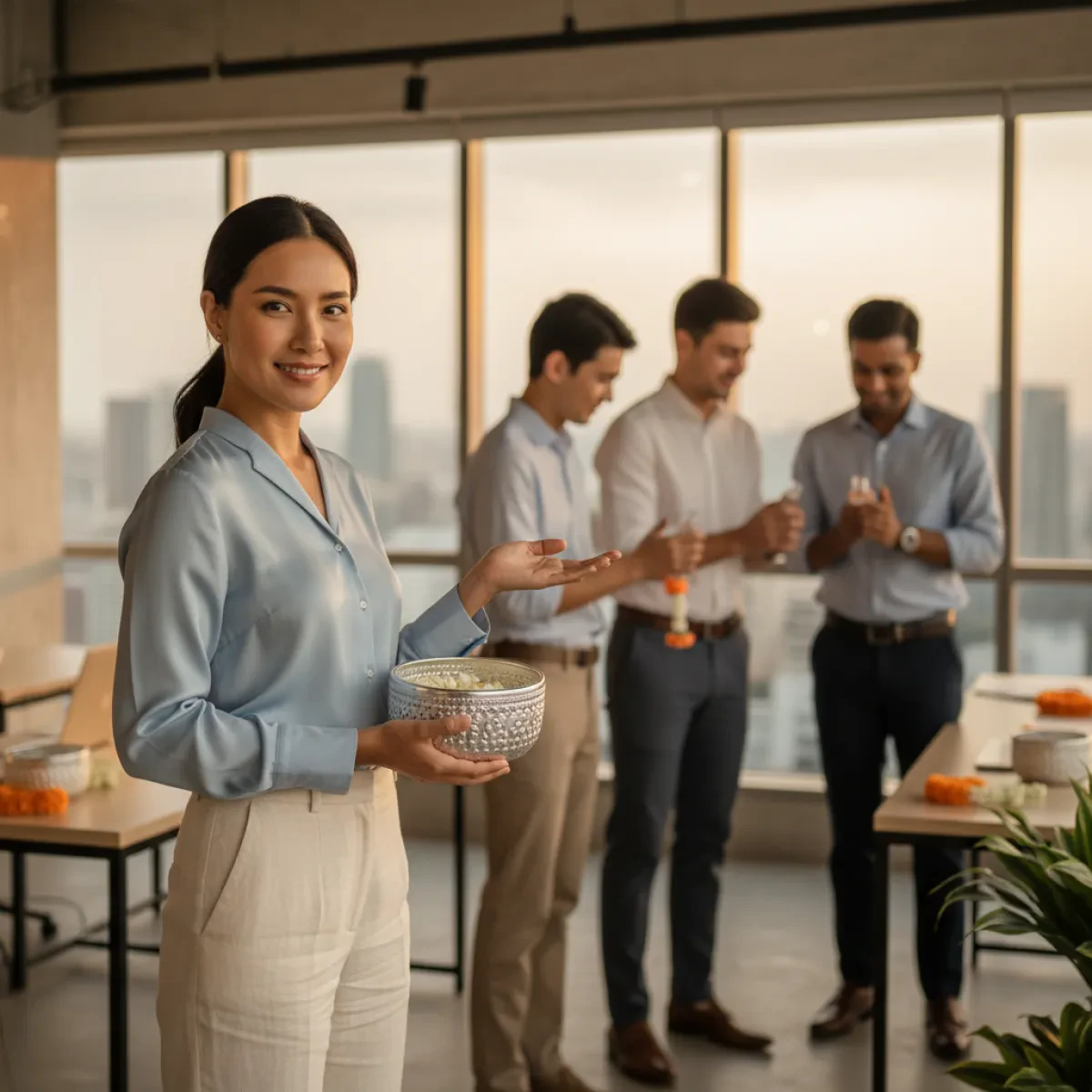
Many Thai workplaces hold internal Songkran celebrations before the official holiday begins. These events often include a Rod Nam Dam Hua ceremony, in which younger or more junior employees pour scented water gently over the hands of senior staff, managers, and elders. The gesture symbolises gratitude, respect, and a request for blessings in the year ahead. According to the Nation Thailand, elders respond by rubbing the water on their foreheads and offering blessings for health and prosperity.
For a foreign professional participating for the first time, the ceremony may feel unfamiliar. A few practical observations from reporting on workplace culture in Thailand: the water is poured gently with two hands, not splashed. Flower garlands or small gifts are sometimes presented alongside the water. The atmosphere is typically warm, respectful, and quietly emotional, particularly when longstanding colleagues participate. Kneeling or sitting lower than the elder receiving the water is the customary posture, reflecting the hierarchical values that, as workplace culture experts note, form the foundation of Thai professional life.
Foreign professionals who participate sincerely tend to earn genuine goodwill. According to multiple cross-cultural workplace guides, Thai colleagues generally appreciate the effort, even when the gestures are imperfect. The key, as reported by cultural advisors, is showing willingness rather than performing flawlessly. This is not a ritual that demands expertise from outsiders; it asks for respect.
Co-working Infrastructure During the Festival
For remote workers and freelancers who are not embedded in a Thai office, the more pressing question during Songkran is often logistical: where to sit and work when much of the city is celebrating.
Bangkok
Bangkok's co-working ecosystem has grown substantially. According to a 2024 market analysis, the Thailand co-working space market was valued at approximately USD 107 million in 2023 and is projected to grow significantly through 2030. Major spaces in districts like Thonglor, Ekkamai, Ari, and Punnawithi generally remain open during Songkran, though hours may be modified. Some venues, such as those offering 24/7 member access, provide continuity for professionals with deadline-driven work. Spaces like True Digital Park in the Punnawithi area, along with various operators in Thonglor, are frequently cited among the more reliable options during holiday periods.
Monthly co-working memberships in Bangkok typically range from approximately 3,500 to 7,000 THB (roughly USD 105 to 210), with day passes generally available from around USD 8 to 15, according to multiple nomad resource sites. Connectivity tends to be strong; average fixed-line broadband speeds in Bangkok are often reported as comparable to those in major European cities, and many co-working spaces offer dedicated fibre lines.
Chiang Mai
Chiang Mai, historically one of Southeast Asia's most popular digital nomad destinations, celebrates Songkran with particular intensity. The Old City area and the moat become focal points for the water festival, and foot traffic, noise, and street closures can make getting to a workspace more challenging than usual.
Many remote workers in Chiang Mai gravitate toward the Nimman area during Songkran, which tends to be somewhat quieter for focused work while still offering proximity to the celebrations. Well-known co-working spaces in the city, including Punspace, The Social Club, and Alt Chiang Mai, generally maintain regular or slightly reduced hours. Punspace, for instance, reportedly offers 24/7 access for monthly members. Monthly memberships in Chiang Mai's co-working spaces typically run from 2,000 to 4,000 THB (approximately USD 60 to 120), making them notably more affordable than Bangkok equivalents. For those comparing Southeast Asian workspace ecosystems, the HCMC tech startup ecosystem also offers competitive co-working rates.
Practical Tips for Songkran Week
Remote workers who have navigated Songkran in previous years commonly suggest several preparations. Confirming co-working space hours directly with the venue before the holiday is widely recommended, as published schedules may not always reflect Songkran adjustments. Stocking up on groceries and essentials before April 12 is considered prudent, given that many local shops and restaurants close. Waterproof bags for laptops and electronics are frequently mentioned as near-essential items for anyone venturing outdoors, since water splashing in public areas is widespread and often unavoidable during the festival days.
The Sitting Question: Productivity During a National Celebration
The notion of "sitting through" Songkran raises a broader question that many location-independent professionals confront: how to maintain productivity when the surrounding environment is in full celebration mode.
Several patterns tend to emerge among experienced remote workers in Thailand during Songkran week.
Front-loading the Work Week
Many professionals report shifting their heaviest deliverables to the days before the holiday, treating April 13 to 15 as low-productivity or off days. This mirrors strategies discussed in reporting on seasonal productivity shifts in other expat destinations. The approach requires planning client communications in advance and setting expectations with teams in other time zones.
Split Scheduling
Thailand's UTC+7 time zone creates natural overlap windows that can be exploited during disrupted weeks. As reported by multiple remote work guides, mornings in Thailand (roughly 6:00 to 10:00 AM local) typically overlap with late afternoons and evenings in Central European Time, while late evenings in Thailand (around 8:00 to 11:00 PM local) can catch early mornings on the US East Coast. A split schedule, with focused work in the early morning and a second block in the late evening, allows professionals to stay responsive to Western clients while freeing the chaotic midday and afternoon hours for festival participation or simply avoiding the streets.
Asynchronous Communication
The time zone gap between Thailand and Western markets inherently encourages asynchronous workflows. Remote work productivity guides frequently note that professionals in Southeast Asia can use project management platforms, recorded video updates, and detailed written briefs to maintain momentum without requiring real-time availability during disrupted periods. This approach can be especially valuable during Songkran, when even a trip to a coffee shop may involve navigating water-soaked streets.
Cost of Living Context for the Songkran Period
Songkran falls during Thailand's hot season, and the weeks surrounding the festival can be among the most expensive for domestic travel and accommodation, particularly in popular celebration cities like Chiang Mai, Phuket, and Bangkok's Khao San Road area. However, for foreign professionals already established in a rental, the impact on monthly costs is generally modest.
As of early 2026, reported monthly living costs for a comfortable lifestyle in Bangkok typically range from approximately USD 1,500 to 2,500, depending on neighbourhood and lifestyle choices. One-bedroom apartments in popular remote worker districts like Ari, Thonglor, and Ekkamai reportedly average around 22,000 THB (approximately USD 660) per month, though these figures have reportedly risen over recent years.
Chiang Mai remains substantially more affordable, with comfortable monthly budgets commonly cited in the range of USD 1,000 to 1,500. Modern apartments in the city reportedly start from around 7,500 to 15,000 THB (approximately USD 225 to 450) per month. For freelancers comparing Southeast Asian destinations, these cost structures are often weighed against other regional hubs; the Latin American freelance hub comparison offers a different cost baseline.
Workplace Culture Beyond the Water: What Foreign Professionals Report
Songkran is not an isolated cultural event; it reflects deeper values that shape Thai professional life year-round. Understanding these values during the festival period often helps foreign professionals navigate the workplace more effectively at all times.
Hierarchy and the Concept of Face
According to multiple cross-cultural business guides, Thai workplace culture places significant emphasis on hierarchy based on age and seniority. The Rod Nam Dam Hua ceremony is an annual expression of this value system. Foreign professionals who show awareness of hierarchical norms, using the title "Khun" followed by a first name when addressing colleagues, avoiding public disagreement with senior staff, and deferring to elders in group settings, tend to build stronger working relationships. As reported by the Jackson Grant cross-cultural guide, indirect communication is the norm, and direct criticism, especially in front of others, is generally considered a serious breach of etiquette.
Relationship Building
Thai professional culture, as noted by several workplace advisors, tends to prioritise personal relationships and rapport. Songkran gatherings, office celebrations, and informal post-holiday conversations about hometown visits and family traditions often serve as relationship-building moments. Foreign professionals who engage with these conversations, asking about colleagues' Songkran plans, sharing their own experiences of the festival, and expressing genuine curiosity, are frequently cited as integrating more smoothly into Thai teams. This relational emphasis applies across collaborative workspace cultures worldwide, though its expression in Thailand carries distinctly local flavour.
Common Challenges Foreign Professionals Report
Based on reporting from multiple expat and remote work communities, several recurring challenges surface during Songkran:
- Client miscommunication: Clients in other countries may not be aware of Songkran or its impact on Thai business operations. Proactive communication about reduced availability, ideally sent a week or more in advance, is commonly recommended.
- Isolation: Freelancers without Thai social networks sometimes describe feeling excluded from the family-oriented celebrations. Co-working communities and expat social groups in Bangkok and Chiang Mai often organise Songkran-themed events that can help bridge this gap.
- Logistical disruption: Transportation, food delivery, and basic services can be significantly disrupted. Planning ahead for meals, transport, and supplies is widely considered essential during the holiday period.
- Noise and distraction: The festival is loud. Music, water fights, and street celebrations can make working from a home office difficult, particularly in areas close to major celebration zones. Noise-cancelling headphones are frequently mentioned as a near-necessity.
- Electronics and water damage: The risk of water damage to laptops, phones, and other devices during outdoor transit is real. Waterproof cases and bags are standard recommendations from experienced residents.
When to Consult a Qualified Professional
Foreign professionals working in or from Thailand during Songkran, or at any time, may face questions about work authorisation, tax residency, and compliance obligations. These topics are complex and highly individual. Readers are encouraged to consult a licensed immigration attorney, a qualified tax advisor familiar with their home jurisdiction and Thailand, or an employer of record provider for any questions about legal status, tax filing, or employment compliance. This article does not constitute legal, tax, or immigration advice.
Making the Most of the Season
Songkran is, at its core, a celebration of renewal. For foreign professionals in Thailand, whether employed by a Thai company, freelancing from a Chiang Mai co-working space, or managing a remote team across multiple time zones, the festival offers a window into the values that animate Thai professional and personal life. The Rod Nam Dam Hua ceremony is not merely a workplace obligation; it is an invitation to participate in a culture that values gratitude, humility, and connection.
Sitting through Songkran does not have to mean sitting it out. With thoughtful scheduling, proactive client communication, and a willingness to engage with the traditions rather than simply endure the disruption, the festival can become one of the more memorable and professionally enriching experiences of a year spent working in Thailand.