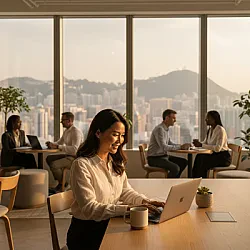
- Hong Kong's unique property market often necessitates creative ergonomic solutions, such as vertical storage and foldable workstations, to accommodate remote work in compact apartments.
- The Top Talent Pass Scheme (TTPS) and Quality Migrant Admission Scheme (QMAS) are primary routes for high-income professionals and graduates seeking to establish a base in the city.
- Due to average humidity levels exceeding 80 percent, local experts recommend mesh furniture over leather to maintain thermal comfort and prevent posture shifts.
- Hybrid work remains prevalent in the financial and tech sectors, with many companies in Central and Quarry Bay offering stipends for home office equipment.
The Reality of Remote Work in the Vertical City
For professionals in Hong Kong, the concept of a home office is frequently defined by the constraints of local real estate. With the average living space in the Special Administrative Region (SAR) hovering around 40 to 50 square metres, the luxury of a dedicated study is a rarity reserved for the uppermost tier of the market. Instead, remote work often occurs in multi-functional spaces—dining tables in Wan Chai service apartments, window bays in Kennedy Town, or compact desks in shared living areas in the New Territories. This spatial reality presents specific ergonomic challenges that differ significantly from the sprawling home office setups common in North America or Australia.
Despite these constraints, Hong Kong remains a premier destination for global talent, particularly in the financial services, legal, and technology sectors. The introduction of initiatives like the Top Talent Pass Scheme (TTPS) has accelerated the influx of high-earning professionals and graduates from the world's top 100 universities. For these individuals, securing a visa is often the first step, followed immediately by the logistical challenge of fitting a global career into a high-density urban environment.
[LOCAL_IMMIGRATION_RESOURCE_en-hk]Ergonomics in the Nano-Flat Era
Occupational therapists in Hong Kong note that the "neutral spine" principle becomes difficult to maintain when depth is limited. A standard corporate desk is typically 80cm deep, but residential furniture available in local districts like Mong Kok or Causeway Bay often scales down to 45cm or 60cm to fit smaller floor plans. This reduced depth forces the user closer to walls or windows, potentially compromising the viewing distance to monitors.
The Geometry of Compact Sitting
The standard ergonomic recommendation is the 90-90-90 rule: elbows, hips, and knees positioned at 90-degree angles. However, adapting this to a Hong Kong apartment requires precision. If a worker uses a dining table, the height is often fixed at 75cm—too high for typing without elevating the shoulders. Local physiotherapists suggest that if the table cannot be lowered, the chair must be raised. This creates a gap between the feet and the floor, which must be bridged with a footrest to prevent lumbar strain. In the absence of commercial footrests, improvised solutions using stable household items are common temporary fixes.
Vertical space utilisation is another strategy emphasised by interior designers in the city. Wall-mounted monitors or clamp-style monitor arms (readily available in computer centres in Sham Shui Po or Wan Chai) allow the screen to be positioned at eye level without consuming valuable desk surface area. This approach helps prevent "tech neck," a condition increasingly cited in local health reports regarding telecommuters.
Climate-Adaptive Furniture Choices
Ergonomics in Hong Kong is as much about thermal regulation as it is about geometry. The territory experiences high humidity for a significant portion of the year, often exceeding 80 percent. While air conditioning is ubiquitous, the micro-climate between a user and their chair can lead to discomfort.
Market data from Southeast Asian furniture retailers indicates a strong preference for high-tensile mesh chairs over traditional leather executive options. Leather and heavy foam tend to retain heat and moisture, causing users to subconsciously shift into poor postures to cool down. Mesh backrests promote airflow, essential for sustaining focus during long trading hours or late-night conference calls with counterparts in London or New York.
The Professional Landscape: Visas and Employment
Establishing a remote or hybrid career in Hong Kong usually intersects with the region's specific immigration framework. The Immigration Department (ImmD) manages several schemes designed to attract skilled capital.
Top Talent Pass Scheme (TTPS)
Launched to attract high-income earners and academic elites, the TTPS is available to individuals with an annual income of at least HKD 2.5 million or graduates from the world's top 100 universities with relevant work experience. Successful applicants are granted a two-year visa without the prior requirement of securing an offer of employment, allowing them flexibility to set up their home workspace before commencing work.
Quality Migrant Admission Scheme (QMAS)
This points-based system targets highly skilled individuals in specific sectors such as Fintech, ESG, and Creative Industries. Unlike the General Employment Policy (GEP), which requires an employer sponsor, QMAS entrants can enter the territory to pursue innovation and professional opportunities independently, often working from home or co-working spaces initially.
General Employment Policy (GEP)
For professionals transferred by multinationals or hired by local firms, the GEP remains the standard route. It requires a confirmed offer of employment at a market-rate salary. In these cases, the employer typically handles the sponsorship, and some larger corporations may provide a one-time stipend (often ranging from HKD 3,000 to HKD 10,000) for setting up a compliant home office.
Active Sitting and The Urban Commute
Given the spatial limitations, "active sitting" has gained traction among Hong Kong's health-conscious workforce. This involves using stools that engage core muscles or alternating between sitting and standing. While standing desks are popular, their footprint can be prohibitive in smaller flats. Table-top risers offer a collapsible alternative that can be stowed away when the workday ends.
Furthermore, the remote work lifestyle eliminates the natural physical activity associated with commuting via the MTR or walking through the Central-Mid-Levels escalators. Health experts advise replicating this activity by integrating scheduled walks into the daily routine. The proximity of country parks to urban areas—such as the Dragon's Back or Victoria Peak trails—offers remote workers accessible options for physical decompression that are unique to the territory's geography.
Sourcing Equipment Locally
Residents have access to a tiered market for ergonomic equipment. For high-end, brand-name ergonomic chairs, showrooms in Central and Quarry Bay cater to corporate clients and individuals willing to invest HKD 8,000 or more. Mid-range options are widely available in chain furniture stores across the territory, while budget-conscious workers often source electronics and peripherals from the specialized markets in Sham Shui Po.
For those whose living situations simply cannot accommodate a healthy work setup, Hong Kong boasts a dense network of co-working spaces. Locations in Sheung Wan, Causeway Bay, and Kwun Tong offer professional-grade ergonomic furniture and high-speed connectivity, serving as a viable alternative for QMAS entrants and freelancers who require a separation between rest and work environments.
When to Seek Professional Help
Persistent musculoskeletal issues should be addressed by qualified professionals. Hong Kong has a robust network of registered physiotherapists and occupational therapists. Many private clinics in Central and Tsim Sha Tsui offer workplace assessments to diagnose environmental causes of pain. It is generally noted that relying solely on furniture adjustments is insufficient if chronic pain persists; medical guidance is the recommended course of action.
Employers in the region are also increasingly cognizant of their duty of care. Under the Occupational Safety and Health Ordinance, employers have a responsibility to ensure the safety and health of their employees, typically extending to ensuring that remote work arrangements do not pose significant health risks. Employees are advised to check their employment contracts regarding coverage for occupational therapy or ergonomic assessments.