Working Remotely in One of the World's Densest Cities
Singapore's reputation as a global hub for finance, technology, biotech, and logistics draws professionals from around the world. With multinational regional headquarters concentrated across the Central Business District, Jurong Innovation District, and one-north, remote and hybrid work arrangements have become standard practice for a growing share of the workforce. Yet the physical reality of working from home in Singapore presents a distinct set of challenges that professionals in less space-constrained cities rarely encounter.
According to data from the Housing and Development Board (HDB), approximately 80% of the resident population lives in public housing flats. Newer Build-To-Order (BTO) units, while thoughtfully designed, generally prioritise communal living efficiency. A typical four-room BTO flat offers roughly 90 square metres of floor area, shared among household members. For professionals who need a dedicated workspace, carving out an ergonomic home office within these constraints requires strategic thinking about furniture, airflow, lighting, and vertical space.
The Seating Question in Small Singapore Flats
The office chair is typically the single largest piece of furniture in any home workspace, and in a Singapore bedroom or common room doubling as an office, its footprint matters enormously. Standard executive chairs with wide wheelbases spanning 70cm or more can dominate a small room and obstruct pathways, which is a practical concern in households where space is shared.
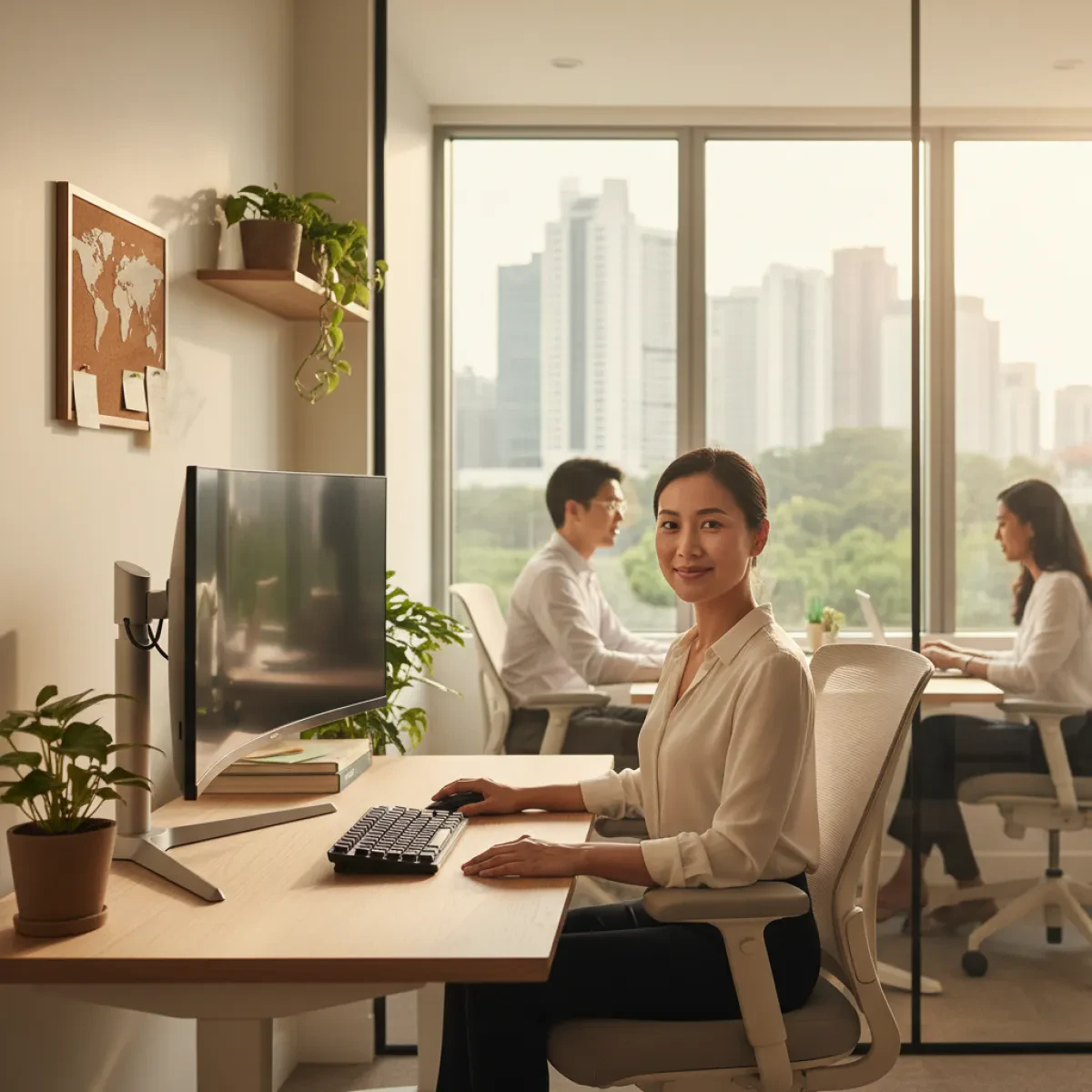
Ergonomic task chairs, widely available at retailers across Singapore such as those in Ubi and Alexandra, tend to offer a more practical alternative. These models generally feature mesh backrests for breathability (a meaningful advantage in Singapore's tropical humidity) and narrower bases of around 55 to 60cm. Armless variants or those with flip-up armrests allow the chair to tuck fully under a desk, reclaiming floor space during off-hours. The key ergonomic principle remains maintaining a neutral spine position, a concept well documented in occupational health literature globally.
Selection Considerations for Compact Seating
- Wheelbase diameter: Compact models at 55 to 60cm can make a notable difference in tight corners or shared bedrooms.
- Breathability: Mesh materials are generally preferred in Singapore's climate, where indoor temperatures can feel warm even with air conditioning running at moderate settings.
- Seat depth adjustment: In shallow workspaces, being able to adjust the seat pan helps ensure proper distance from the monitor.
- Price range: Ergonomic task chairs in Singapore typically range from around SGD $200 for entry-level models to SGD $800 or more for well-known brands, based on retail listings as of 2025.
Desk Solutions for HDB and Condo Units
The standard corporate desk depth of 80cm was designed for an era of bulky monitors. Modern flat screens and laptops function comfortably on surfaces as shallow as 60cm, which is significant for Singapore apartments where every centimetre counts. Wall-mounted desks and floating shelf configurations have gained popularity among homeowners looking to eliminate table legs and free up visual and physical floor space.
For those living in rented HDB flats or condominiums where drilling into walls may not be permitted under tenancy agreements, standing desk converters that sit atop existing dining tables offer a practical workaround. However, these converters often raise the keyboard height, which can necessitate a higher chair position and the addition of a footrest to keep leg angles correct. Stability is also a consideration: a surface that wobbles during typing can lead to subtle postural compensations and potential wrist strain over time.
Some professionals in Singapore have reported success with narrow console-style desks, typically around 40 to 50cm deep, paired with wall-mounted monitor arms. This combination allows a functional workstation along a corridor wall or in a section of the living room without consuming the space a conventional desk would require.
Monitor Placement: Reclaiming Depth in Tight Layouts
When desk depth is reduced, the screen naturally moves closer to the eyes, which can contribute to digital eye strain. Occupational health guidelines generally suggest an arm's length as the optimal viewing distance. On a desk of 45 to 60cm depth, monitor arms become essential tools. By clamping the display to the desk's rear edge or mounting it on the wall, users can push the screen back and reclaim 15 to 20cm of surface area that a standard monitor stand would otherwise occupy.
Vertical monitor stacking, rather than side-by-side dual screens, has gained traction among Singapore's tech professionals. This configuration uses vertical space rather than desk width and can reduce the lateral neck rotation associated with wide dual-monitor setups. The primary display is generally positioned at eye level, with the secondary screen above for reference material.
Climate Factors: Heat and Humidity in the Home Office
Singapore's equatorial climate, with average temperatures around 27 to 31°C and relative humidity frequently exceeding 80%, introduces ergonomic challenges that extend beyond furniture. Small rooms with running computers, external monitors, and charging devices can generate noticeable heat buildup.
- Airflow management: Placing a desk directly beneath an air conditioning vent can create drafts that contribute to neck and shoulder stiffness. Circulator fans that bounce air off walls, rather than directing it at the user, are often cited as a balanced solution. Maintaining comfortable airflow without direct cold air exposure is a common consideration in Singapore's home office discussions.
- Lighting in high-density housing: Many HDB units, particularly lower-floor flats in mature estates, receive limited natural light due to proximity to neighbouring blocks. Task lighting with adjustable colour temperature can help compensate. Cool white light in the range of 4000K to 5000K is generally associated with concentration, while warmer tones assist with winding down. Monitor light bars, which illuminate the desk surface without consuming any desk space, are particularly well suited to compact setups.
- Humidity control: Prolonged exposure to high humidity can affect both the user's comfort and the longevity of equipment. Small dehumidifiers, common in Singapore households, can help regulate moisture levels in a dedicated work area.
Co-working as an Alternative: The Third Space Calculation
There is a practical threshold where a home setup, regardless of optimisation, may not be viable due to noise, limited space, or household dynamics. Singapore's co-working sector has expanded significantly, with spaces available across the island from Tanjong Pagar to Tampines. Monthly hot-desk memberships in centrally located spaces generally start from around SGD $300 to $500, according to publicly listed rates as of 2025.
The financial calculation between investing in home office upgrades and paying for co-working access is one that many Singapore-based remote professionals weigh carefully. In a city where residential rental prices remain among the highest in Asia, the cost per square metre of dedicating a room to an office can be substantial. For some, a co-working membership effectively replaces the need for a larger flat.
Career Context: Why Workspace Quality Matters for Singapore Professionals
Singapore's position as a regional headquarters destination means that many remote and hybrid professionals operate in high-performance sectors where sustained focus is essential. The Ministry of Manpower (MOM) oversees the various work pass categories that bring international talent to Singapore, including the Employment Pass (EP) for professionals, the ONE Pass for top-tier global talent, and the Tech.Pass for established technology leaders. The COMPASS points-based framework, which generally applies to EP applications, reflects the city-state's structured approach to workforce planning.
Visit the Ministry of Manpower website to apply for Employment Passes, S Passes, or check your work permit eligibility.
Singapore uses a points-based COMPASS framework for Employment Pass applications. Employers must submit applications on behalf of foreign workers.
For professionals navigating careers in demanding sectors, such as those exploring the Singapore fintech ecosystem and its cultural dynamics, a well-designed workspace is frequently viewed not as a luxury but as infrastructure for career longevity. Long hours in front of screens, common in finance and technology roles, amplify the consequences of poor ergonomic setups. Chronic discomfort can reduce output quality and, over time, lead to musculoskeletal issues that affect professional performance.
Professionals considering work pass applications or career transitions in Singapore may wish to consult a licensed immigration adviser or employment lawyer for guidance on specific regulatory requirements.
Making the Environment Disappear
The ultimate goal of workspace optimisation in a compact Singapore flat is to make the physical environment fade into the background. When the chair supports the spine correctly, the monitor sits at the right height and distance, lighting minimises eye fatigue, and airflow keeps the room comfortable despite the tropical heat outside, the professional can direct full attention to the work itself.
Whether operating from a converted bedroom in a Punggol BTO, a study nook in a Tiong Bahru walk-up, or a balcony-adjacent corner in a Bukit Timah condominium, the principles remain consistent: prioritise adjustability, think vertically, control the climate, and never compromise on the fundamentals of posture and screen placement. In a city where space is measured in precious square metres, thoughtful ergonomic design is one of the most practical investments a remote professional can make.