The Unique Density of the Hong Kong Home Office
For professionals in Hong Kong, the concept of a home office often differs sharply from the global standard. In a city where the average living space per person hovers around 15 square metres, and where 'nano-flats' under 20 square metres are a distinct segment of the property market, finding space for a dedicated workstation is a logistical feat. Data from the Rating and Valuation Department indicates that domestic rents in prime districts like Central and Western remain among the highest globally, forcing many remote workers to prioritise efficiency over expanse.
The shift towards hybrid work arrangements, accelerated by recent global events, has permanently altered the residential landscape. Professionals under the Top Talent Pass Scheme (TTPS) or the General Employment Policy (GEP) often arrive to find that their accommodation requires significant adaptation to support a full-time work-from-home routine. The challenge is not simply fitting a desk into a room; it is about carving out a zone of professional focus within a multi-functional living space that might also serve as a dining room, gym, and bedroom.
Structural Realities: Bay Windows and Diamond Living Rooms
Hong Kong's residential architecture presents specific opportunities and constraints for ergonomic setups. A common feature in many estates built after the 1980s is the deep concrete window sill, or 'bay window'. While often criticised for eating into usable floor area, these ledges have become focal points for creative home office conversions. Interior designers in the region frequently commission custom desk surfaces that bridge the bay window recess, effectively extending the usable depth of the room by 50cm or more without encroaching on the walkway.
However, the infamous 'diamond-shaped' living room found in many large estates creates awkward angles that standard rectangular desks fail to accommodate. This structural quirk drives a robust local market for custom-built furniture and modular solutions that can hinge or fold. For tenants unable to renovate, the focus shifts to mobile solutions that can be stowed away, acknowledging that in a 350-square-foot apartment, a permanent office footprint is a significant luxury.
Seating Solutions for the Compact Footprint
In the context of Hong Kong's limited square footage, the executive chair is often an impractical choice. A standard office chair with a 70cm wheelbase can dominate a small room, making thoroughfare difficult. Consequently, the local market has seen a surge in demand for 'slimline' ergonomic task chairs. These models prioritise vertical back support and lumbar adjustment but reduce the footprint of the base and armrests.
Ergonomic experts note that the visual weight of furniture impacts the psychological sense of space. Mesh-backed chairs, popular in Hong Kong's humid climate, offer breathability and transparency that solid upholstery lacks. Furthermore, armless designs or those with flip-up arms allow the chair to slide completely under a desk when not in use, reclaiming vital floor space. This 'stowability' is a critical factor for residents in districts like Wan Chai or Kennedy Town, where every square foot carries a premium rental value.
Criteria for High-Density Ergonomics
- Base Diameter: Compact models with a 55-60cm base allow for tighter movement between furniture.
- Breathability: Given that Hong Kong's humidity averages over 80% for much of the year, mesh materials prevent heat buildup during long working hours.
- Mobility: Chairs with high-quality casters that function on tiled floors (common in HK homes) prevent surface damage and reduce noise transfer to neighbours below.
The Desk Equation: Verticality and Depth
Standard corporate desks typically offer a depth of 80cm, a luxury rarely afforded in local residential layouts. A depth of 60cm is generally accepted as the minimum for a functional setup involving a laptop and external keyboard. To compensate for reduced surface area, vertical integration becomes essential. Wall-mounted shelving units and 'ladder desks' are ubiquitous in Hong Kong design, utilising ceiling height for storage rather than floor area.
For those in rental properties where drilling into walls is prohibited, clamp-on monitor arms are indispensable. By elevating the screen and pushing it flush against the wall, users can reclaim 15-20cm of desk depth. This adjustment is crucial for maintaining the correct viewing distance—approximately an arm's length—to prevent digital eye strain, a common complaint among financial and legal professionals working extended hours.
Climate Control: Managing Heat and Humidity
Ergonomics in Hong Kong extends beyond posture to environmental control. The subtropical climate creates a specific set of challenges for electronics and comfort. High humidity levels can lead to mould growth on leather furniture and potential damage to sensitive equipment. Dehumidifiers are standard fixtures in local home offices, often placed near the workstation to maintain a relative humidity around 50-60%.
Air conditioning placement is another critical ergonomic factor. In small rooms, split-type air conditioners are often mounted directly above the only viable desk location. Direct cold drafts hitting the neck and shoulders can cause muscle contraction and stiffness, mimicking the symptoms of poor posture. Air deflectors or circulator fans that bounce air off walls are common interventions to create a diffuse cooling effect rather than a direct blast.
Lighting and Acoustic Management
High-density living often means windows face directly into neighbouring units or light wells, resulting in limited natural illumination. This necessitates a reliance on artificial task lighting. Monitor light bars, which sit atop the screen and illuminate the desk surface without causing glare, are particularly favoured in compact HK setups as they require no desk space. Lighting specialists suggest adjustable colour temperatures: cool white (5000K) to stimulate concentration during the day, shifting to warm white (3000K) in the evening to aid the transition away from work mode.
Acoustics also play a major role in the ergonomics of concentration. With thin walls and high population density, noise pollution is a constant variable. Noise-cancelling headphones are virtually mandatory for remote meetings. Additionally, the use of soft furnishings—rugs, curtains, and acoustic foam panels—can help dampen reverberation in rooms dominated by hard surfaces like concrete and tile.
The Economic Trade-off: Home vs. Co-working
There comes a point where the cost of upgrading a home setup to professional standards outweighs the benefits, particularly given Hong Kong's property prices. For a professional renting a 400-square-foot apartment in Sheung Wan, dedicating 50 square feet to a permanent office represents a significant portion of their monthly rental expenditure. In some cases, this 'virtual cost' exceeds the membership fees of local co-working spaces.
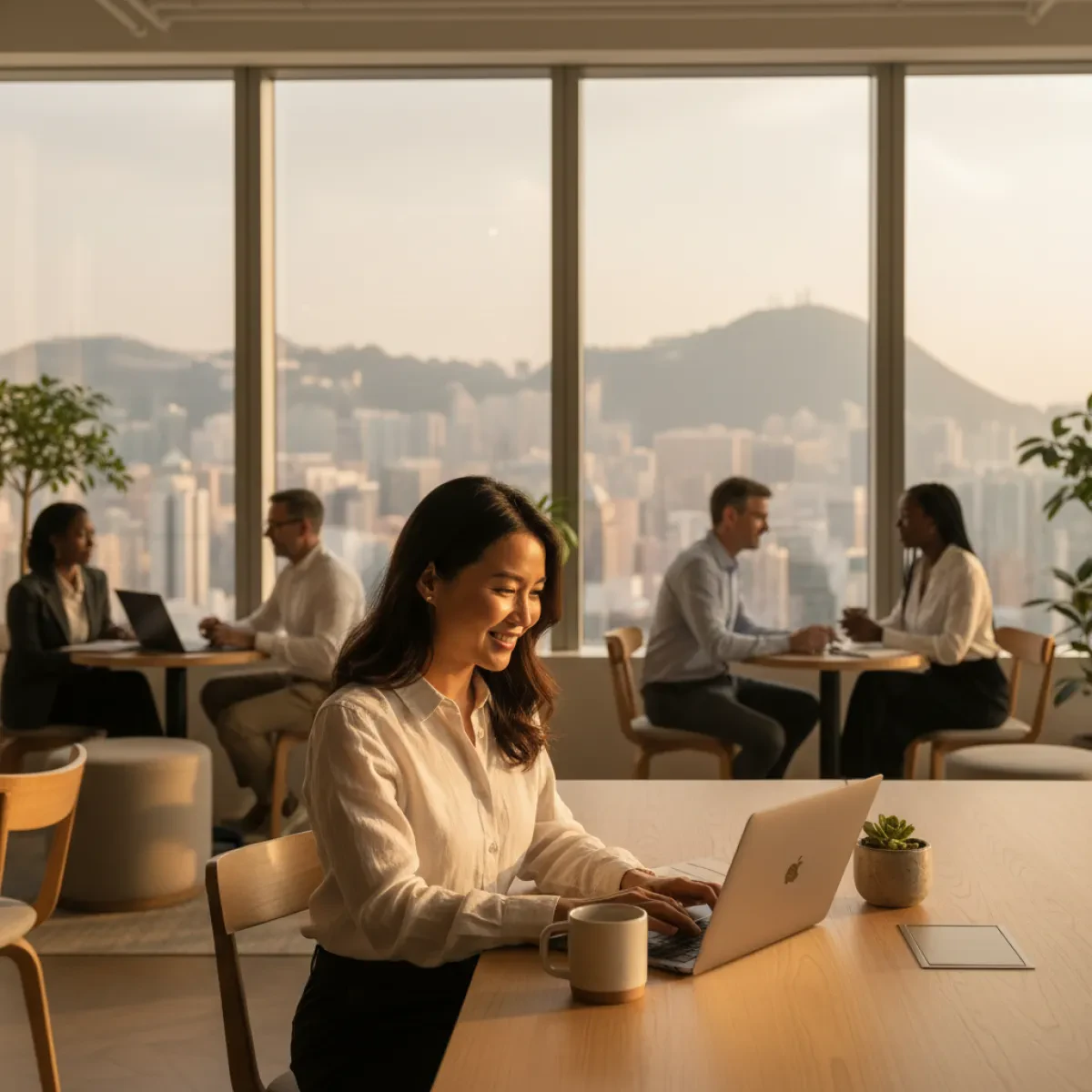
Hong Kong hosts a mature network of shared workspaces, from major chains in Central to boutique operations in industrial buildings in Kwun Tong and Wong Chuk Hang. These spaces offer ergonomic furniture, enterprise-grade internet, and climate control as part of the package. For expatriates and locals alike, the calculation often involves weighing the privacy of home against the ergonomic and economic efficiency of a dedicated third space. [LOCAL_IMMIGRATION_RESOURCE_en-hk]
Professional Sustainability in a Fast-Paced Market
The intensity of Hong Kong's business environment, particularly in sectors like finance, law, and logistics, demands sustained high performance. Career longevity is increasingly linked to physical well-being. Physiotherapists in the Central business district report a high incidence of 'tech neck' and repetitive strain injuries linked to improper home working setups. For professionals navigating the local job market, whether under the Quality Migrant Admission Scheme (QMAS) or standard employment visas, investing in a proper ergonomic foundation is not merely a comfort choice but a career preservation strategy.
Ultimately, the goal is to create a workspace that disappears into the background, allowing the user to focus entirely on their output. In Hong Kong, this requires creativity, discipline, and a willingness to adapt standard advice to the unique constraints of the vertical city. By prioritising vertical storage, climate control, and proportionate furniture, it is possible to build a world-class workstation within a modest footprint.